Clinicians Name the Treatment. Parents Search the Problem.
Practices describe care in clinical terms like play therapy or Cogmed. Parents search in plain words, usually about the problem. Here's how to close that gap.
 Natalie HenleyFounder, Digital Practice Growth
A practice owner asked me recently whether we should switch our ads from “play therapy” to “child therapy.” Her hunch was that parents don’t talk the way clinicians do. She was right, and her question gets at something I see on almost every mental health practice website we look at.
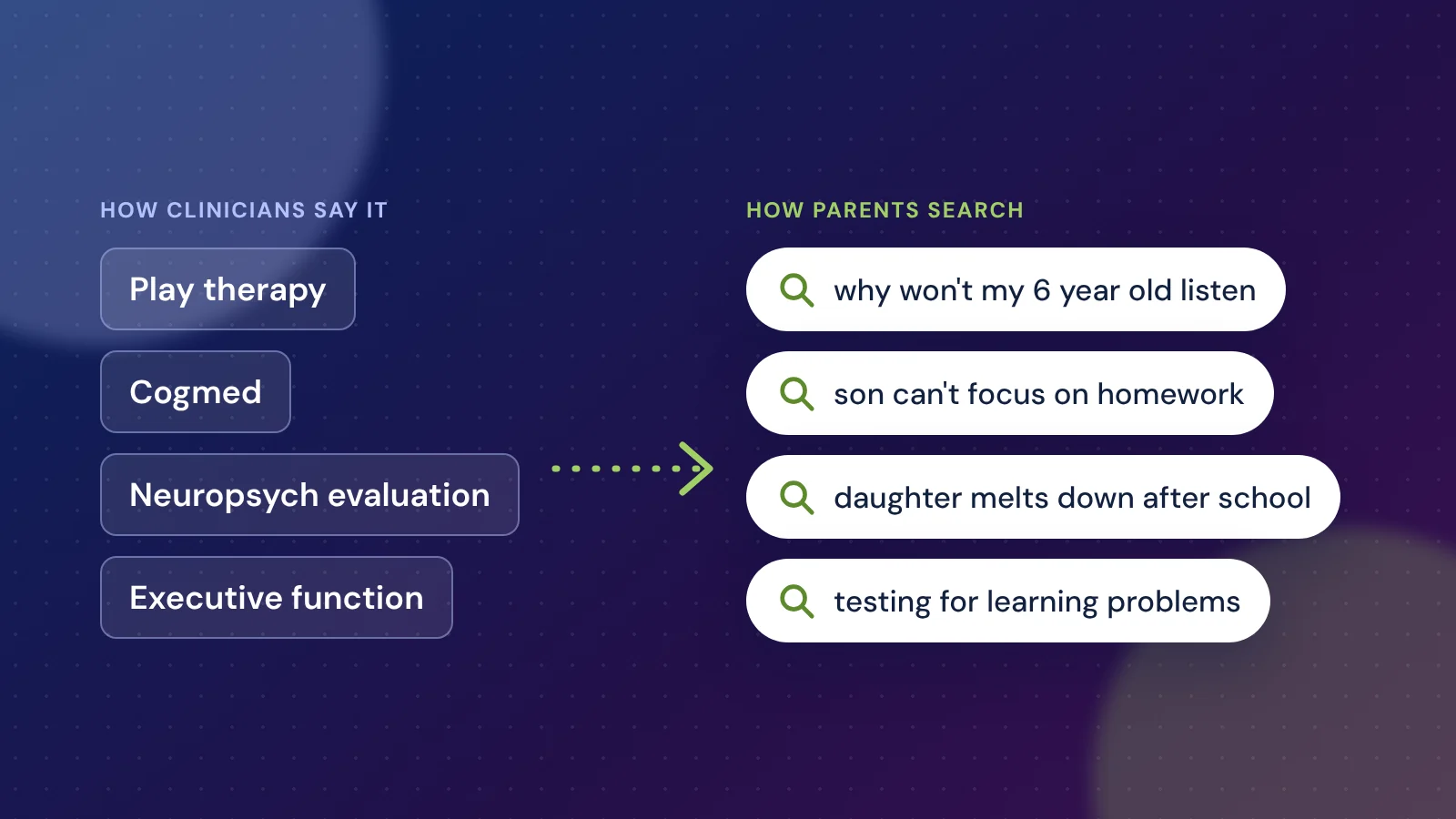
Clinicians describe their work by what they do. Parents search by what they’re worried about.
Two vocabularies
Inside a practice, the words are precise: play therapy, Cogmed working memory training, neuropsychological evaluation, executive function, parent child interaction therapy. Those terms matter clinically, and they’re how your team talks every day. So they end up everywhere: page titles, service menus, Google Business Profile services and ad keywords.
Parents don’t start there. A parent sitting up at 10pm types something closer to:
- “why won’t my 6 year old listen”
- “son can’t focus on homework”
- “daughter melts down after school”
- “testing for learning problems near me”
- “child therapist near me”
Not one of those uses a treatment name. If your site only speaks in clinical terms, Google and AI tools have very little to connect those searches to your practice, and the parent never finds out you offer exactly what their child needs.
Treatment names still matter, just later
Named searches aren’t useless. People do search “play therapy” and “Cogmed,” and in the accounts we’ve managed, those searches tend to convert well. Someone who types the name has usually read about it, or been told by a pediatrician, teacher or another provider what to look for.
There just aren’t many of them. Most families learn the name of the treatment at the end of their research, not the beginning. So if your marketing only answers the named search, you’re waiting for families to do all the translating themselves. Many of them will book with whoever explained it in plain words first.
Where the gap usually shows up
- Service pages titled with the clinical name only. “Cogmed” as a page title tells a worried parent nothing. “Cogmed: Help for Kids Who Struggle to Focus and Remember Instructions” tells them they’re in the right place.
- Opening paragraphs that define the method instead of the problem. Start with what the parent is seeing at home, then explain how your approach helps.
- Ads built only around treatment names. They reach a small slice of the families who are looking, and they miss everyone who hasn’t learned the term yet.
- FAQs written the way a clinician would ask them. “What is play therapy?” is fine. “Will my child just be playing?” is the question parents actually have.
- Clinician bios that list certifications without saying who they help. Credentials build trust once a parent knows this person works with kids like theirs.
How to close the gap
- Collect the parent’s words. Ask your intake team what parents say on the first call, before anyone uses a clinical term. Those phrases are your keyword list. The search terms report in Google Ads and the queries in Search Console are the other two places to look.
- Lead with the problem, then name the treatment. Keep the clinical term on the page so people searching it by name still find you, but put the parent’s problem first.
- Write problem-first content that points to the named service. A post on “why does my child melt down after school?” can explain the pattern and link to your play therapy page. That’s how a parent learns the name of the treatment from you instead of from another practice.
- Split your ads by vocabulary. Put plain-language and problem searches in one campaign and treatment-name searches in another, each with its own budget. Otherwise the broad terms use up most of the money and the smaller, ready-to-book group gets very little.
- Ask your clinicians to translate. In our interviews, we ask: “How would a parent describe this before they knew the word for it?” Their answer often becomes the headline.
The short version
Your clinical vocabulary is accurate, and it belongs on your site. It just can’t be the only vocabulary there. Meet parents with the words they’re already using, then teach them the name of the care that helps.
If you’d like to know which words your site and ads are actually showing up for, the $499 Checkup covers exactly that.